
A child can learn a word from a book. But can they confidently use it in a conversation?
A child can write an answer on a worksheet. But can they stand on a stage and express an idea?
A textbook can explain what teamwork means. But has a child actually experienced working with others?
These questions highlight something important about early education:
Children don't learn only by reading. They learn by doing, experiencing, speaking, creating, participating and discovering.
Books and classroom learning are undoubtedly important. They help children develop foundational knowledge, language, numeracy and understanding. But during the early years, education needs to go beyond what is printed on a page.
Because when children are given opportunities to experience what they learn, knowledge becomes something they can actually use.
Learning Should Not Stop at the Page
Imagine a child learning about colours.
They could look at pictures in a book and memorise their names.
Or they could mix colours, observe what happens, create something of their own and explain what they discovered.
Both approaches introduce the child to colours.
But the second approach creates an experience.
That experience encourages the child to observe, think, experiment, communicate and remember.
This is the value of hands-on learning.
For young children, the world around them is a classroom. Every conversation, activity, performance, game, project and interaction can become an opportunity to learn.
The goal is not to move away from books.
It is to make learning bigger than books.
Conversation Is Also Learning
One of the most important skills a young child can develop is the ability to communicate.
Yet communication cannot be developed simply by reading a chapter about it.
Children need opportunities to actually speak.
To introduce themselves.
To ask questions.
To answer questions.
To share their ideas.
To talk to their classmates.
To listen to others.
To express what they feel and think.
A simple classroom conversation can teach a child things that no worksheet can fully capture.
It helps them organise their thoughts, choose their words, listen carefully and become comfortable expressing themselves.
And the more children practise communicating in a supportive environment, the more naturally their confidence begins to grow.
Communication is not just a subject to be taught. It is a skill to be experienced.
Confidence Comes From Participation
We often describe a child as “confident” or “shy”.
But confidence is not simply a personality trait that some children are born with.
It can be developed through experiences.
A child who is given regular opportunities to speak, participate and perform gradually becomes more comfortable being seen and heard.
That might begin with something very small:
Standing in front of the class.
Saying a few sentences.
Answering a question.
Participating in a group activity.
Playing a character.
Sharing a drawing.
Giving a small presentation.
Over time, these experiences add up.
The child begins to realise:
“I can do this.”
And that belief can become one of the most valuable things a child carries with them.
The Stage Is More Than a Performance
A stage performance may look like a fun school activity.
But for a young child, it can be a powerful learning experience.
Standing in front of an audience requires preparation, memory, communication, expression and courage.
A child learns to use their voice.
They learn to pay attention.
They learn to work with others.
They learn what it feels like to make a mistake and continue.
And perhaps most importantly, they experience the feeling of being proud of themselves after doing something they once found difficult.
The applause at the end is wonderful.
But the real learning happens before the applause.
It happens when a child takes that first step onto the stage.
Learning Through Real Experiences
Children are naturally curious.
They want to touch things, ask questions, try things and understand how the world works.
That curiosity should have a place in the classroom.
Instead of always giving children the answer, meaningful learning can sometimes begin with a question:
“What do you think will happen?”
Then comes the opportunity to try.
Observe.
Discuss.
Make a mistake.
Try again.
And discover.
This is how children begin developing important skills such as problem-solving, critical thinking, creativity and decision-making.
They aren't simply memorising information.
They are learning how to learn.
Activities Turn Ideas Into Experiences
Hands-on activities give children an opportunity to connect concepts with the world around them.
A lesson about nature can become an observation activity.
A lesson about language can become a conversation or storytelling exercise.
A lesson about numbers can become a practical counting or problem-solving activity.
A lesson about teamwork can become a group project.
A lesson about creativity can become an opportunity to build, draw, design or perform.
When children actively participate, they become part of the learning process.
And when they become part of the process, learning can become more meaningful and memorable.
Children Also Learn From Each Other
Learning doesn't happen only between a teacher and a child.
It also happens between children.
When children work together, they learn to listen to different ideas.
They learn to take turns.
They learn to share.
They learn to cooperate.
They learn that their way of thinking may not always be the only way.
Sometimes they lead.
Sometimes they follow.
Sometimes they help someone else.
Sometimes they need help themselves.
These small interactions are helping children develop social skills that will remain important throughout their lives.
What Happens When Children Are Given the Freedom to Express?
Give a child a blank sheet of paper, and you may get something unexpected.
Give them a question, and you may get an answer you didn't anticipate.
Give them a stage, and you may discover a performer.
Give them a conversation, and you may discover a storyteller.
Give them a problem, and you may discover a creative thinker.
This is why early education should leave room for children to explore and express, rather than expecting every child to learn and respond in exactly the same way.
There is value in allowing children to be curious.
There is value in allowing them to ask “why”.
There is value in allowing them to make mistakes.
And there is enormous value in giving them opportunities to discover what they can do.
Preparing Children for More Than the Next Grade
The early years of education are about much more than preparing children for the next examination or the next grade.
They are about building foundations.
A child who learns to communicate confidently today can carry that confidence into future classrooms.
A child who learns to work with others today can become a better collaborator tomorrow.
A child who learns not to fear mistakes can approach new challenges with greater confidence.
A child who develops curiosity can continue asking questions long after a particular lesson is over.
These are the foundations that help children grow—not just as students, but as individuals.
At Minerva, Learning Goes Beyond the Books
At Minerva, we believe that young children deserve an education that allows them to experience learning, not simply receive it.
Books and academic foundations remain an important part of the classroom. But alongside them, children need opportunities to speak, interact, create, perform, explore and participate.
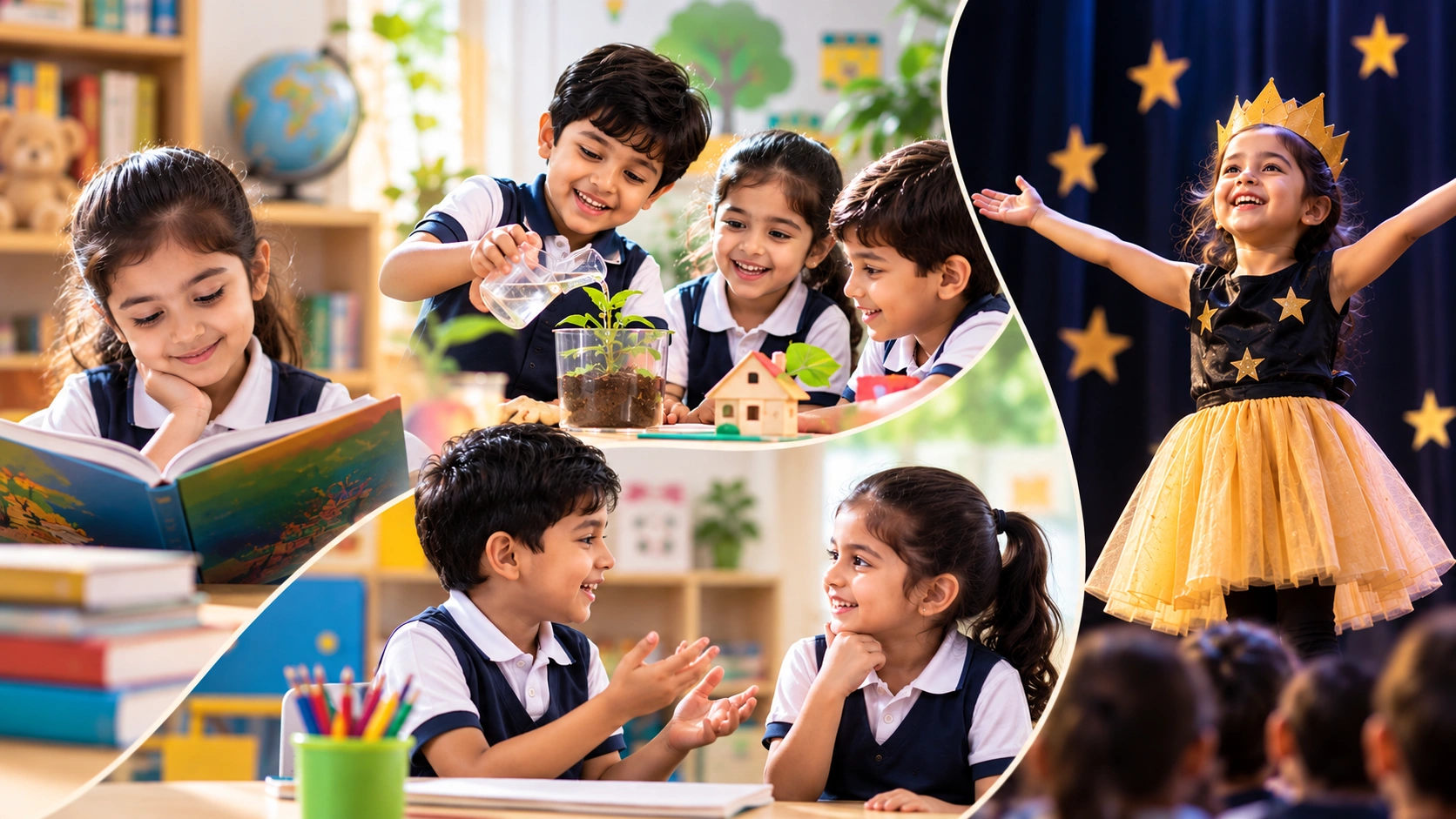
From classroom conversations and hands-on activities to stage performances and collaborative experiences, children are encouraged to actively take part in their learning journey.
Because when a child participates, they don't just learn a lesson.
They develop confidence.
They develop communication skills.
They learn to express themselves.
They learn to work with others.
They learn to take responsibility.
And they begin to understand that learning isn't something that happens only when a book is open.
Learning happens everywhere.
It happens when a child asks a question.
When they try something for the first time.
When they stand on a stage.
When they speak to a friend.
When they solve a problem.
When they make a mistake and try again.
When they proudly say, “I did it!”
Because the goal of early education is not simply to fill a child's mind with information.
It is to give them the confidence, curiosity and skills to discover the world for themselves.
At Minerva, we believe children should not only learn about the world.
They should have the opportunity to experience it.